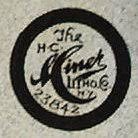
H.C. Miner Lithographic Company
The H.C. Miner Lithographic Company, founded in 1896 in New York, was established by H.C. Miner and his son, H.C. Miner Jr. Over the years, the company gained a reputation for producing high-quality lithographic prints and became a significant player in the print industry. Initially, it was known for its expertise in creating promotional materials for a variety of industries, but its most notable contributions were to the entertainment sector, particularly in the production of movie posters, advertising, and other lithographic works for Hollywood studios.
In 1908, the company underwent a major reorganization, with Hugo Zigfield taking over as president. Under his leadership, the company expanded its capabilities and continued to produce high-quality lithographs for major film studios. H.C. Miner Lithographic Co. was especially known for its work with United Artists and Fox Film Corporation, becoming the go-to company for the lithographic needs of these major Hollywood studios. The company was responsible for creating promotional posters, advertising materials, and other graphic products for films, helping to shape the visual identity of Hollywood during this era.
By 1935, after nearly four decades in operation, the H.C. Miner Lithographic Company ceased operations, marking the end of an era in the New York lithography scene. Despite its closure, the company’s legacy lived on, as its work for United Artists and Fox helped shape the iconic movie posters and advertising styles that continue to influence the industry today.
Lithography in Advertisting
Stone lithographers printed with large limestone slabs of various sizes. These stones, typically sourced from quarries such as those in Solnhofen, Germany, were prized for their fine-grained texture, which allowed for detailed artwork. The “Double Royal” stone used for poster advertisements measured 28 by 40 inches and weighed nearly 400 lbs. Advertisements could range from 1-stone lobby posters up to 24-stone billboards. This was an era before photography and modern printing techniques overtook the artistry of hand-drawn lithographs. Grever worked with lithographic stones measuring an impressive 28 by 40 inches, crafting advertising that ranged from single-stone lobby posters to 24-stone billboards. These intricate productions often involved a team of specialized artists – one for lettering, another for scenery – but it was Grever who brought the stars to life with his masterful portraits.
The movie studios exerted strict control over poster designs, including the placement and sizing of stars’ names relative to film titles. Lithographers adhered to these specifications rigorously and required studio approval for any alterations. This ensured brand consistency and satisfied contractual obligations with actors and filmmakers.
Once lithographers completed the plates, these were either shipped to dedicated printing facilities or, in some cases, printed in-house. The finished posters were distributed through various channels, including studio exchanges, independent poster exchanges, and, later, the National Screen Service (NSS).
Larger-format posters, such as three-sheet, six-sheet, and massive twenty-four-sheet designs, were typically sent directly to posting companies. These companies specialized in mounting the advertisements on billboards and other large display surfaces, ensuring prominent visibility in urban and rural areas alike.ools and techniques, artists can achieve a wide range of textures and tones.
Lithographic Process
The lithographic process involves numerous steps. This complex process not only highlights the intricate craftsmanship involved in lithography but also reflects the evolving relationship between technology, artistry, and commercial demands:
- The stone is ground to a flat surface using abrasive materials. The level of smoothness depends on the level of detail required for the artwork.
- The artist drew directly onto the stone’s surface using an oil-based ink or crayon, creating an image that could then be inked and pressed onto paper. The design must be drawn in reverse so that it prints correctly when transferred to paper.
- The stone is treated with a solution of gum arabic and nitric acid. This chemical mixture fixes the greasy drawing into the stone and ensures that non-image areas repel ink.
- The surface is washed with water, which is absorbed only by the non-greasy parts of the stone.
- An oil-based ink is rolled over the surface of the stone. The greasy drawing areas accept the ink, while the water-receptive areas repel it.
- A sheet of paper is carefully placed on the inked stone and the stone and paper are run through a lithographic press. The pressure transfers the ink from the stone to the paper.
The process allows for highly detailed and nuanced images, suitable for artistic and commercial purposes. By using different drawing tools and techniques, artists can achieve a wide range of textures and tones.
 kingoflitho.org